

C42 Design Breakdown
What is GWI™? Guiding on the sensor that takes the picture
GWI™ (Guide While Integrate) lets C42's full-frame imaging sensor guide the mount during the exposure. No guide scope, guide camera, OAG or calibration.
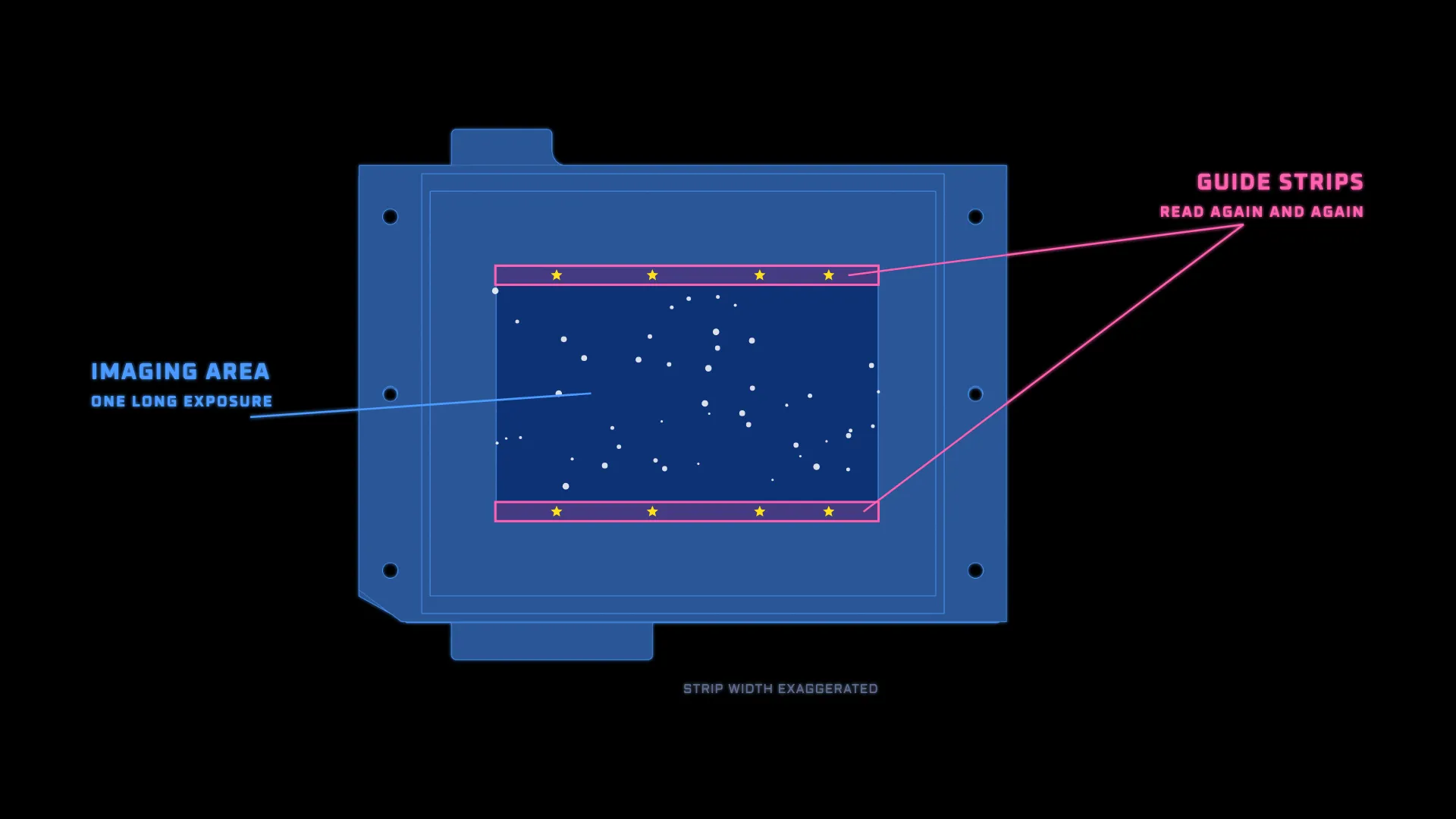
Why does a photograph of the night sky need two cameras?
Look at almost any serious deep-sky rig and you will find a second one. Next to the camera making the picture sits a smaller camera whose only job is to watch one star all night. It has its own optics or prism, its own focus, its own cable and its own setup routine. It does that job well. It is also a big part of why so many people give up on long exposures before they get a single sharp one.
GWI™ (Guide While Integrate) is the on-sensor guiding built into C42. The full-frame sensor taking your photograph also guides the mount, during the same exposure. You don’t need a guide scope, guide camera or off-axis guider, and there is no calibration step before you start.
GWI™ is older than C42. My co-founder Chen Song and I spent years building our own astronomy cameras, and GWI™ started as an idea of mine long before there was a product to put it in. It first worked in 2018, on a scientific sensor in our lab. C42 came later, and it was built around that idea.
The second camera in every deep-sky rig
A tracking mount follows the sky, but never perfectly. Polar alignment always leaves some residual error, the structure flexes slightly as it points across the sky, and every gear train has periodic error. You won’t see any of this on a wide lens with a short exposure. At 400 mm and ten minutes, it turns round stars into short streaks.
Guiding closes the loop. Watch a star, measure how far it drifts, nudge the mount back, and repeat every few seconds for the whole exposure. The real design question is where you watch that star from. Astrophotographers have three established answers, and each works but has a cost.
A guide scope is a small telescope beside the main optics, with its own camera. It is simple and flexible. But the two structures can flex by different amounts as the rig moves and the night cools. When that happens, the guide camera measures one drift while the imaging sensor experiences another. This differential flexure changes with pointing and temperature, so calibration can’t remove it.
An off-axis guider (OAG) uses a small prism in the main light path to send light from the edge of the field to a guide camera. Sharing the light path solves most of the flexure. In exchange, it takes around 20 mm of back focus, the prism needs adjusting, and the guide camera needs its own focus. The prism also needs light outside the main sensor, and many fast full-frame lenses are designed to cover the sensor with very little to spare. On a full-frame camera, a prism pushed far enough in to catch light can shadow the edge of the frame. Kept clear of the frame, it catches almost no light.
A dual-sensor camera puts a small guide sensor in the same body, right beside the main sensor. That gives you one light path and no extra camera. But the lens’s image circle now has to cover both sensors, so cameras of this type today use an APS-C main sensor. On a full-frame lens, only an APS-C-sized part of the image circle becomes your photograph. And the guide sensor sits on its own mount inside the body, with its own focus adjustment.
All three share one more step: guide calibration. Before each session, the software moves the mount in several directions to learn how the guide camera’s pixels relate to the mount’s axes. It is one of the most common frustrations for new users, and it has to be repeated whenever the rig is reassembled.
| Guiding approach | Guide scope | Off-axis guider | Dual-sensor camera | GWI™ on C42 |
|---|---|---|---|---|
| Differential flexure | Can’t be fully removed | Mostly removed | Mostly removed | None: same sensor |
| Extra hardware | Scope, camera, cables | OAG, camera, cables | None (built in) | None |
| Imaging area on a full-frame lens | Full frame | Full frame, prism may shadow an edge | APS-C (current products) | Full frame minus a few edge rows |
| Separate guide focus | Yes | Yes | Yes, its own adjustment | No: focus the image and guiding is in focus |
| Guide calibration | Every setup | Every setup | Every setup | Not needed |
An idea borrowed from radar
The way out came from a different field.
Early tracking radars faced a similar trade-off. A radar could sweep the sky to search, or lock onto one target and follow it, but locking on meant losing sight of everything else. In the 1950s, engineers developed track-while-scan: one radar kept scanning while it also tracked the targets it had found. Two jobs that used to need a choice, or two machines, were handled by one instrument at once.
That gave me the idea, and the name. In astronomy, integrating means collecting light during an exposure: over ten minutes, the sensor integrates photons until a faint galaxy appears. The traditional way is to integrate on one camera and guide on another. Guide While Integrate means doing both on the same sensor, at the same time.
How GWI™ works
C42 uses a Sony IMX410 full-frame sensor. Most of the sensor runs the long exposure as usual. At the same time, narrow strips along its top and bottom edges are read out much faster, over and over. GWI™ measures the centroid of each star in those strips, works out how far it has moved, and sends right-ascension and declination corrections to the mount. The guide strips can even use their own exposure time and ISO, set independently of the main image.
Because guiding and imaging share one sensor, one light path and starlight from the same moment, three things follow:
- Nothing in between can flex. Drift is measured exactly where the photograph is being made.
- No guiding hardware. No guide scope, guide camera, OAG or extra cable.
- Full-frame lenses just work. The guide strips are part of the sensor, so they get light wherever the sensor does. Change lenses or telescopes, including fast full-frame ones, and guiding stays with the camera.
We give guiding accuracy in pixels on purpose. The guide sensor is the imaging sensor, and star trails in your final photograph are measured in pixels too.
Why there is no calibration
Calibration exists to work out, by moving the mount, how the camera’s pixel grid lines up with the mount’s motion. C42 already knows that before the first star appears.
RA, DEC and the HALO CAA (Camera Angle Adjuster) rotation axis all run closed-loop on 23-bit absolute encoders, so the angle of every axis is known at all times, with no homing. The CAA axis tells the system how the camera, and so its pixel grid, is rotated relative to the mount. Every unit’s axis zero points and orthogonality are calibrated at the factory.
So GWI™ starts guiding as soon as the system is running. There’s no star to pick, no calibration routine, and no failed attempts to retry.
Where GWI™ started
GWI™ began as an idea, not a sensor. In 2017 I went looking for a chip that would let me read a few rows quickly, over and over, while the rest of the frame kept exposing, and found a newly developed scientific sensor whose readout we could drive ourselves. I had already brought up two other sensors on our own FPGA boards, and the new one was running in about three months. For the first time, one sensor was integrating an exposure and guiding at the same moment.
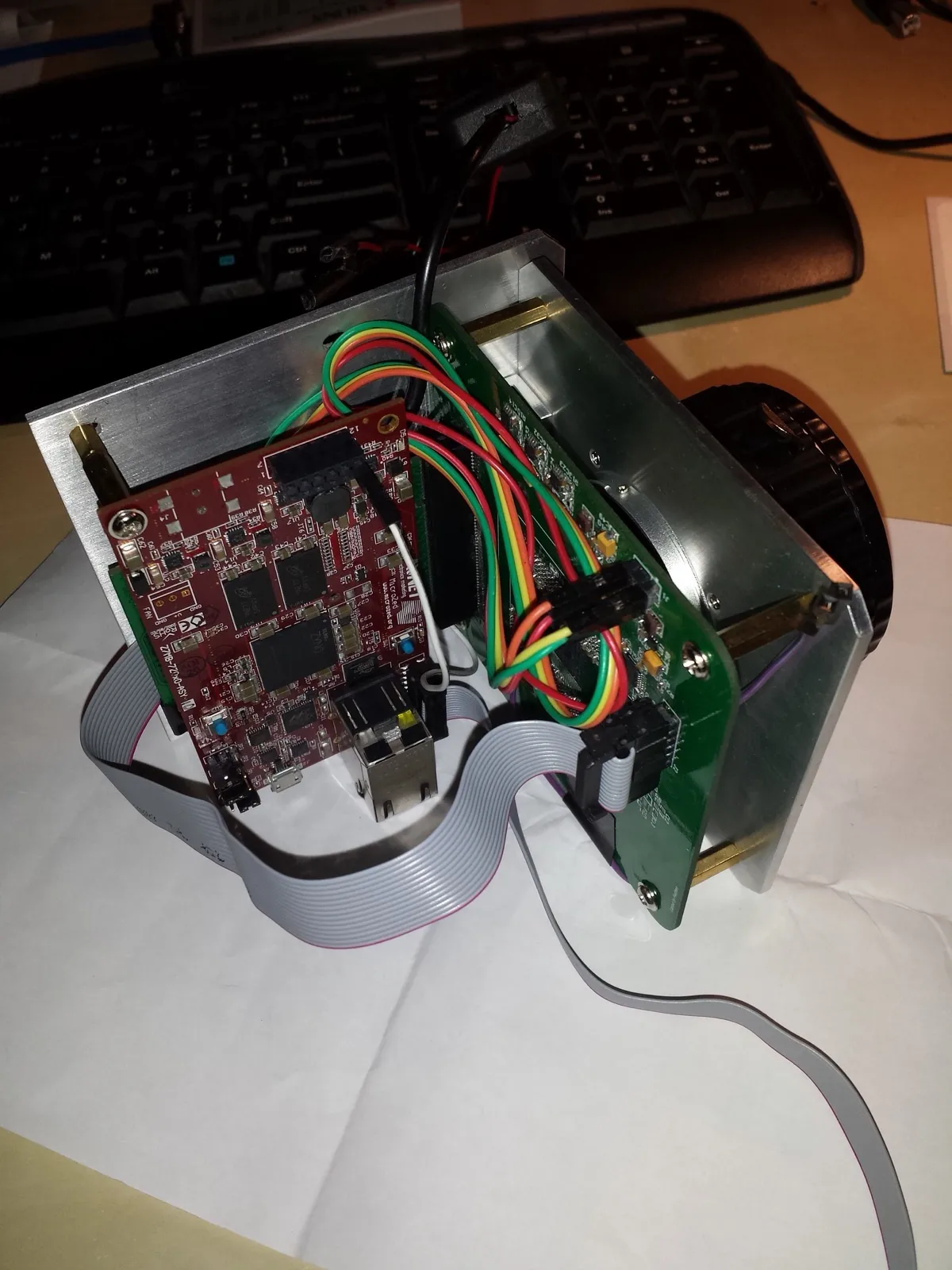
Years later, we finally brought GWI™ to the Sony IMX410: a full-frame sensor with large 5.94 µm pixels, deep full-well capacity and low read noise, built for long deep-sky exposures. Now it guides while it integrates.
The sensor was only part of the job. Making GWI™ into guiding you never have to think about took the rest of the system. The sensor has to know where its guide strips are, the encoders have to know where every axis points, and the rotator has to know the camera’s angle. Without all three, you are back to calibrating before every session.
GWI™ lives inside the camera, so it isn’t something you can add to another one. And guiding with no calibration at all comes from the camera, mount and rotator knowing about each other. That’s why C42 is designed as one system: camera, mount, rotator, touchscreen and app together. We didn’t start from a product line. We started from a question: what would guiding look like if the whole system were built around it?
One camera
So, back to the opening question. With C42, a photograph of the night sky needs one camera. It integrates the light and guides the mount at the same time, with nothing beside it to set up, focus or calibrate. Guiding used to be a skill you had to master before you got your first sharp exposure. With GWI™ it becomes part of the camera, and you barely notice it.
FAQ
What does GWI™ stand for?
Guide While Integrate. The imaging sensor keeps guiding the mount while it integrates, or collects light for, the exposure. The name was inspired by track-while-scan radar.
Do I need a guide camera or guide scope with C42?
No. GWI™ guides on C42's own imaging sensor, with no guide scope, guide camera or OAG.
Does GWI™ need guide calibration?
No. C42's three-axis encoders and factory calibration mean the relationship between the sensor and the mount is already known.
Do I need to focus a guide camera separately?
No. The guide strips are rows of the imaging sensor, so when your image is in focus, guiding is too.
Does GWI™ work with fast full-frame lenses?
Yes. The guide strips are part of the full-frame sensor, so they receive light wherever the sensor does. That is exactly where OAGs and dual-sensor cameras run short.
Does GWI™ work with narrowband filters?
With broadband and multi-band filters, yes: enough starlight reaches the guide strips. Ultra-narrow 3 nm single-channel filters remove most starlight, so some fields won't have a bright enough guide star. Longer guide exposures help. Where they don't, C42's encoder-closed-loop tracking still lets you shoot shorter subframes and stack more of them.
How long can a single guided exposure be?
C42 has made genuine single guided exposures of at least ten minutes. That is a confirmed result, not a ceiling. Longer exposures depend on your setup and on polar alignment, which causes slow field rotation.