C42 Design Breakdown
Smart Telescopes vs. ArcBlue C42 System: What Changes for Your Photography?
Compare smart telescopes and the ArcBlue C42 System in optical choice, imaging capabilities, field operation, and how your equipment can grow with your photography.
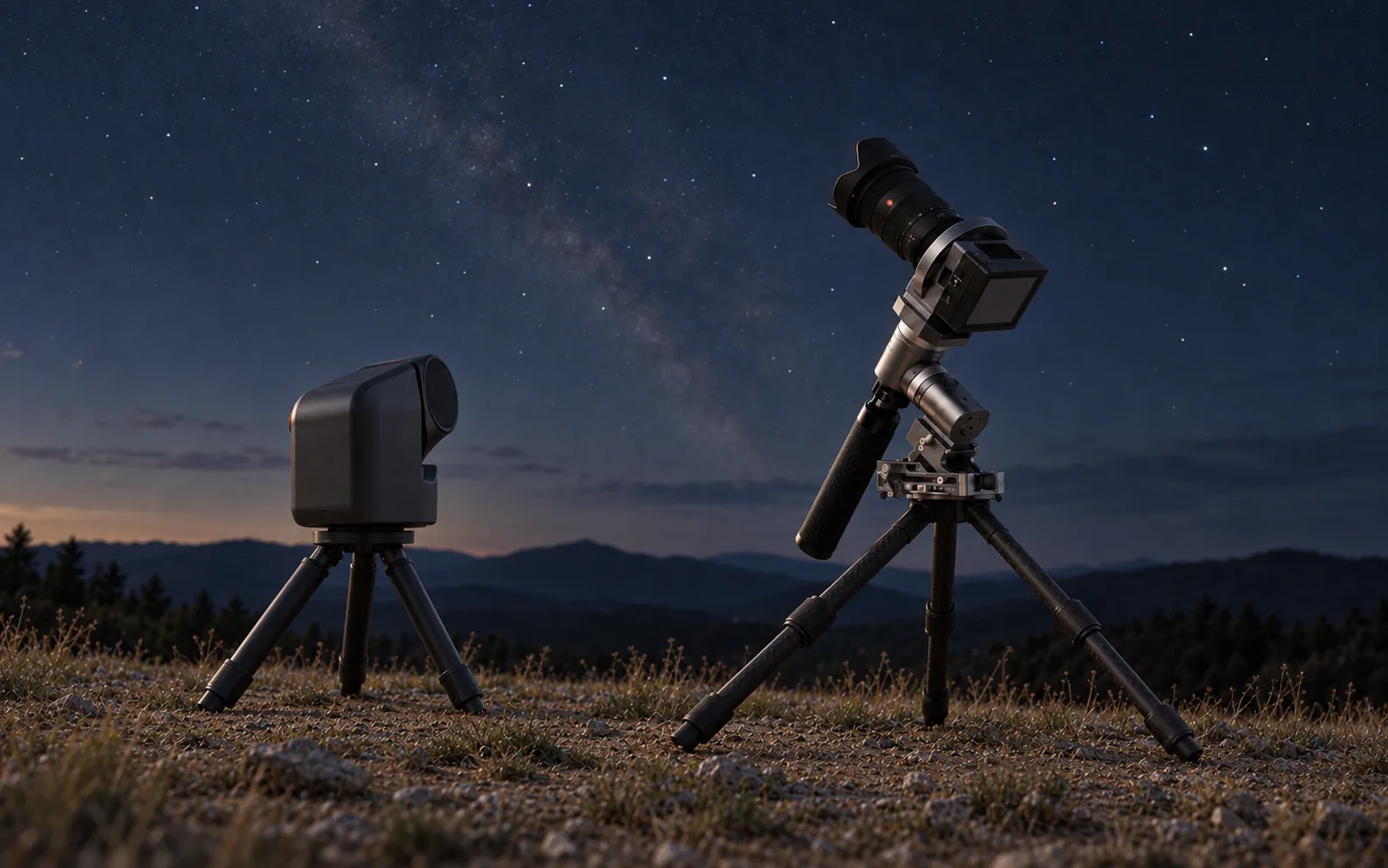
Smart telescopes have made photographing the night sky easier. Optics, camera, tracking, and software arrive ready to work together. Choose a target in an app and watch the shape of a nebula emerge. For someone beginning astrophotography, that is a good place to start.
Whether you are choosing your first setup or already photographing the sky, you may have a particular image in mind. You want the surrounding star field in the frame, a closer view of the structure, or a different treatment of brightness and colour. The subject is the same, but now you care about how to make the image you have in mind.
We designed the ArcBlue C42 Astrophotography System for that creative ambition. It brings together the imaging, guiding, and control needed for professional astrophotography, giving you the means to pursue your ideas and making it easier to put them into practice. If a smart telescope is like a compact camera, we wanted to build a mirrorless camera system: straightforward to operate, with room to take your photography further.
Start with the Image You Have in Mind
The same sky can become very different photographs. The Milky Way can form a landscape with a mountain peak. A nebula can sit within a wide star field or fill a tighter composition that emphasises its structure. Choosing focal length, field of view, and the edges of the frame is part of expressing an idea.
Smart telescopes typically use a fixed main optical combination. They can photograph many objects, but focal length, aperture, and sensor format are selected when you buy the instrument. A large nebula may extend beyond one frame; a small galaxy may occupy only a small part of it. Selecting another target in the app does not change those optics.
C42 lets you choose optics for the frame. Use a wide-angle lens to compose the Milky Way with the landscape, a suitable longer focal length for a wide nebula field, or a telescope for a deep-sky close-up. Native Sony E, Nikon Z, and Canon EF lens mounts, plus an M68 telescope-interface version, let compatible lenses and telescopes you already own join the system. That is the purpose of open optics: when you imagine a different photograph, you have a way to pursue it.
Capture Material You Can Shape into a Finished Photograph
Composition is the beginning. Finishing a photograph also involves collecting light, managing noise, and working with brightness, tonal detail, and colour. We want C42 to support that process from capture through processing, giving photographers material they can work with and refine.
Small-format sensors are common in smart telescopes. C42 uses the full-frame Sony IMX410, approximately 36 × 24 mm with about 24 megapixels and 5.94 μm pixels. With optics that cover the full frame, the larger sensor records a wider field at the same focal length. Thermoelectric cooling supports long-exposure imaging, with a measured temperature difference of 30°C below ambient at full cooling power.
Long exposures require the system to keep tracking the stars. C42’s GWI™ on-sensor guiding runs short guiding exposures alongside long imaging exposures on the same sensor through the same optical path. As the image accumulates light, star-position measurements feed corrections to the mount. C42 supports single exposures up to 600 seconds. With compatible lenses or telescopes, guiding stays in the camera, without a separate guide camera and guide scope to assemble.
C42 provides FITS and DNG RAW output. HDR RAW Fusion produces an FP16 (16-bit floating-point) DNG. You can take the captured material to a computer and continue shaping the image’s tonal relationships, colour, and detail.
For me, professional capability lives in these practical details. From choosing optics to capturing material and processing it, the equipment should support increasingly specific intentions for the photograph.
Spend More of the Night on the Photograph
Creative possibilities matter when you can put them to use. A traditional astrophotography setup brings together the camera, guiding, control, and processing equipment, each requiring connections and configuration. We integrated that recurring work into C42 so that someone heading out with an image in mind can get to the photography sooner.
Select a target and Smart GoTo turns toward it, then corrects the pointing through plate solving. Live View lets you inspect the actual image, magnify it, and adjust focus; compatible electronic lenses support autofocus. HALO CAA rotates the frame to adjust the composition.
Camera angle adjusters that rotate the camera are common. We are the first to build one that rotates the camera and optical tube together. Moving them as one preserves the relationship between the sensor and the optical system, avoiding changes to the flat-field pattern—and the need for recalibration—caused by rotating one relative to the other.
HALO’s high-precision absolute encoder keeps the virtual field of view in the star map synchronised with the equipment’s actual angle in real time. When you need to reframe quickly, you can rotate HALO by hand to capture the composition in front of you, and the field of view in the star map follows the adjustment.
I once had to lie on the ground to see my camera’s screen while focusing for a meteor shower. I kept that experience in mind when we designed C42’s Magnetic Touchscreen. It can stay on the camera or detach for nearby wireless monitoring. With the camera pointed at the sky, you can still inspect the image comfortably and take time over the composition.
A phone can also make a skyward-facing camera easier to view. We still wanted a screen that stays closely connected to the camera. For me, standing beside it, looking where the lens is pointing, and adjusting the picture on its screen is a natural part of photography. Ideas for a composition often emerge in that process. The magnetic screen preserves that familiar experience while letting you move away from the camera when you need to.
I spent years pursuing larger telescopes, and the image still matters to me. I have also come to care more about the process of making it. Equipment that is pleasant to use is equipment you want to take out. Being able to concentrate on the frame encourages another composition, another exposure, another attempt. That is why we bring smart features into a professional system.
A System You Can Build Around Your Photography
Photographic interests change, and equipment keeps developing. Different optics or a new sensor can become a new all-in-one smart-telescope model. Buy one for a wider field, another for a longer focal length, then a newer model, and several complete instruments can accumulate at home. Each time, the desired change is in one part, but another camera, drive mechanism, and control system comes with it.
I would rather the next purchase build on the equipment and experience already there. To try a different view with C42, change the compatible lens or telescope and keep using the camera, guiding, and familiar shooting workflow. The operation you have learned and the lenses you own can continue serving the next photograph.
That is also why we call it C42 Astrophotography System: designed as a whole, with modules that can be used and packed separately. The C42 Camera, Pulsar Mount, HALO CAA, magnetic screen, and app work around one operating workflow, reducing connections and coordination in the field. Pack the camera, mount, and angle-adjustment assembly separately, choose optics for the trip, and fit them alongside your other travel equipment.
It also connects to an existing ecosystem. C42 is built on the INDIGO astronomy framework and is compatible with its ecosystem. Compatible equipment you already own can stay in use, and third-party products can supply optics and accessories we do not make. A photographic system should have room for the ideas that come next.
We want you to use this equipment for longer and explore it more deeply. Even if that means buying fewer complete systems, it is the kind of product we want to make. Experience and feedback from long-term use help us understand what photographers really need and make the next generation better.
We spent ten years preparing to build C42. We have the patience to do it well, and we hope it will stay with you through many years of photography.
Features and Specifications Compared
Framing and Imaging
| Item | Typical smart telescope | C42 |
|---|---|---|
| Optics and creative choices | Built-in main optics with fixed focal length and aperture; targets and compositions fit a predetermined field of view | Choose compatible lenses or telescopes for Milky Way landscapes, wide nebula fields, or deep-sky close-ups, selecting focal length, aperture, and field of view for the image |
| Sensor format and area | Common small formats: approx. 17–71 mm² | Full frame, approx. 36 × 24 mm / 864 mm²; with optics covering full frame, records a wider field at the same focal length |
| Pixel size | Common configurations: 2–2.9 μm | 5.94 μm, used with full-frame cooled imaging, long exposures, and guiding |
| Sensor cooling | Not a standard feature; heat dissipation and cooling arrangements vary by model | TEC cooling, with a measured temperature difference of 30°C below ambient at full power, reducing dark current during long exposures |
Capture and Operation
| Item | Typical smart telescope | C42 |
|---|---|---|
| Single-exposure duration | Typically seconds to tens of seconds; individual guided designs support minutes | Up to 600 s per exposure with simultaneous on-sensor guiding |
| Guiding integration | Individual models include guiding designed around their existing optics | GWI™ shares the imaging sensor and optical path; stays available when compatible optics change, without a separate guide camera and guide scope |
| Tracking system | Commonly alt-az; equatorial modes on some products | Pulsar equatorial mount with 23-bit encoder feedback and servo correction, working with GWI corrections based on the actual star image |
| Composition angle | App-based framing tools, with the method varying by model | HALO CAA rotates the camera and optics together to adjust frame orientation while preserving their relative position |
| Viewing and field control | Primarily phone / tablet app | App + detachable magnetic screen; Live View magnification and focus control, with autofocus for compatible electronic lenses; the separate screen leaves your phone available |
| Capture storage | Typical built-in capacities: 25–225 GB | Camera: 8 GB eMMC + selectable SSD up to 2 TB, providing room for large collections of original captures on extended outings |
Equipment and Expansion
| Item | Typical smart telescope | C42 |
|---|---|---|
| Reusing existing optics | Built-in main optics typically cannot be replaced with photographic lenses you already own | Native Sony E, Nikon Z, and Canon EF lens mounts, plus an M68 telescope-interface version, let existing compatible lenses and telescopes stay in use |
| Software and accessories | Primarily used through the manufacturer’s app and associated accessories | Built on the INDIGO framework and compatible with its ecosystem; retain compatible equipment and choose third-party optics and accessories |
| Packing and transport | Typically packed as an integrated main unit with fixed optics | Pack the camera, mount, and angle-adjustment assembly separately; choose lenses and telescopes for the trip |
| Optical upgrades | A different main optical specification can require another complete instrument | Change compatible optics while retaining the camera, guiding, and control workflow; new purchases build on the existing system |
Smart-telescope figures describe representative configurations reviewed in September 2026. Sensor areas are calculated from imaging dimensions; sensor format and pixel size alone do not rank image quality. The C42 cooling temperature difference is a full-power test result.
How Do You Want to Photograph This Sky?
Perhaps you already photograph landscapes or portraits with a familiar camera. You know how a different focal length or a small change in composition can transform a picture. We want to bring that creative freedom under the stars, with full-frame cooled imaging, guiding, and smart control to help you realise the image.
If you are beginning to imagine how you would photograph a nebula, compose the Milky Way with the landscape, or turn a night’s captured material into a finished image, C42 is the equipment we designed for you. Bring the lens you want to use. Start with the photograph you have in mind.
