Built for the Eclipse: The HDR Story Behind C42
How a 29EV eclipse shot shaped C42's in-camera HDR pipeline.
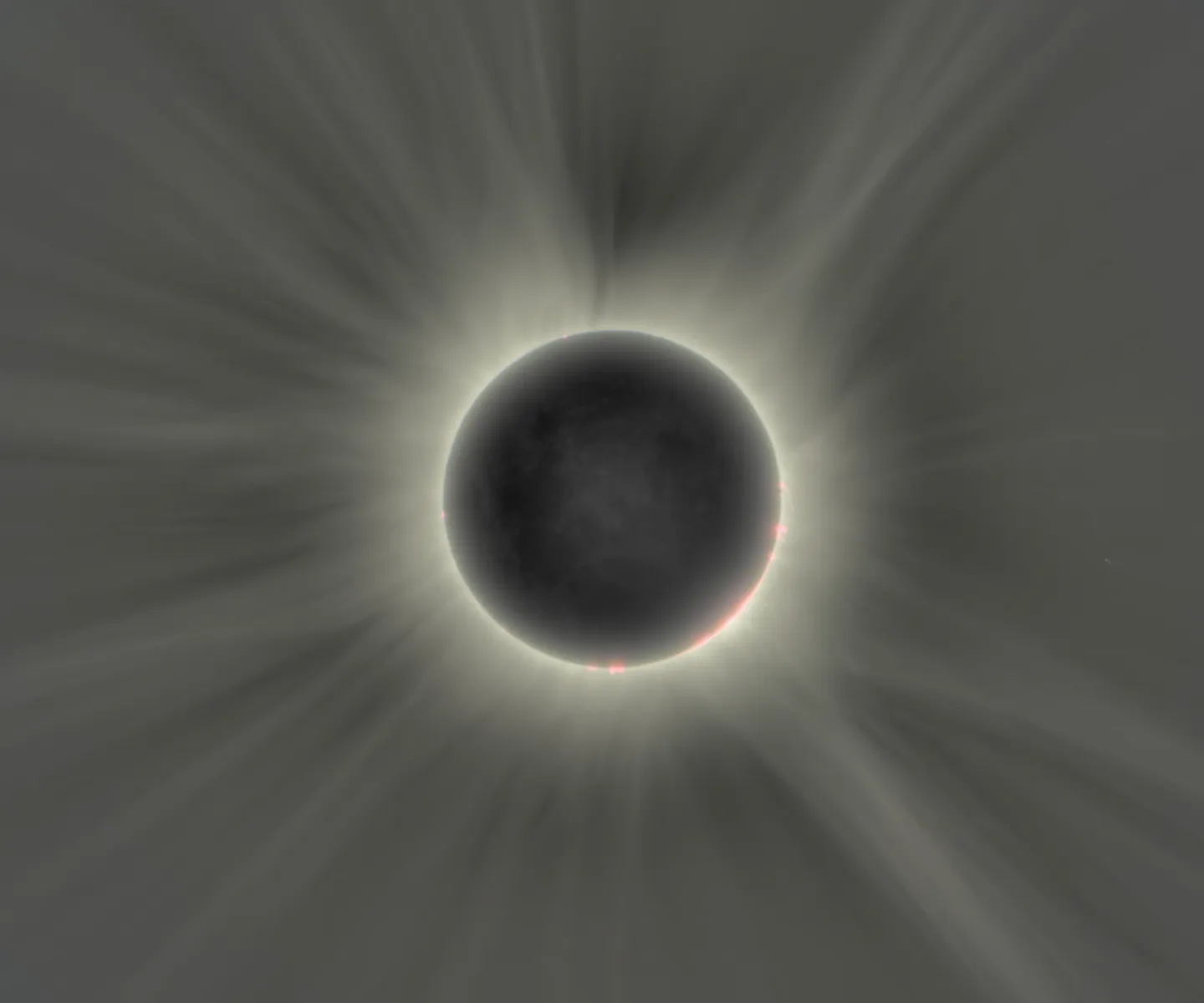
How a 29EV eclipse shot shaped C42’s in-camera HDR pipeline.
01 | The Worst Lighting Test You Can Give a Camera
Astrophotographers have a name for one of the hardest timelapse problems: the Holy Grail. You start in one kind of light and end in another, all while trying to keep the exposure smooth and the image alive.
A total solar eclipse is that problem turned vicious. The sun disappears. The corona comes alive. Bright prominences, thin outer structures, and the dark face of the Moon all sit in the same frame. And you don’t get a second take.
That’s the problem C42 was built to solve.
C42 is a smart, full-frame astrophotography system built around the C42 Camera, combining tracking, cooling, guiding, fast storage, wireless control, and onboard image processing. The point isn’t to make the sky look fake. The point is to keep more of what was actually there.
02 | HDR That Starts Before the File Exists
On C42, HDR isn’t a filter. It starts at capture.
In the eclipse workflow, C42 shoots a burst of five bracketed exposures, ranging from 1/10,000s to 1s. Short frames protect the bright solar features. Longer frames pull out the faint outer corona and the quieter detail around it.
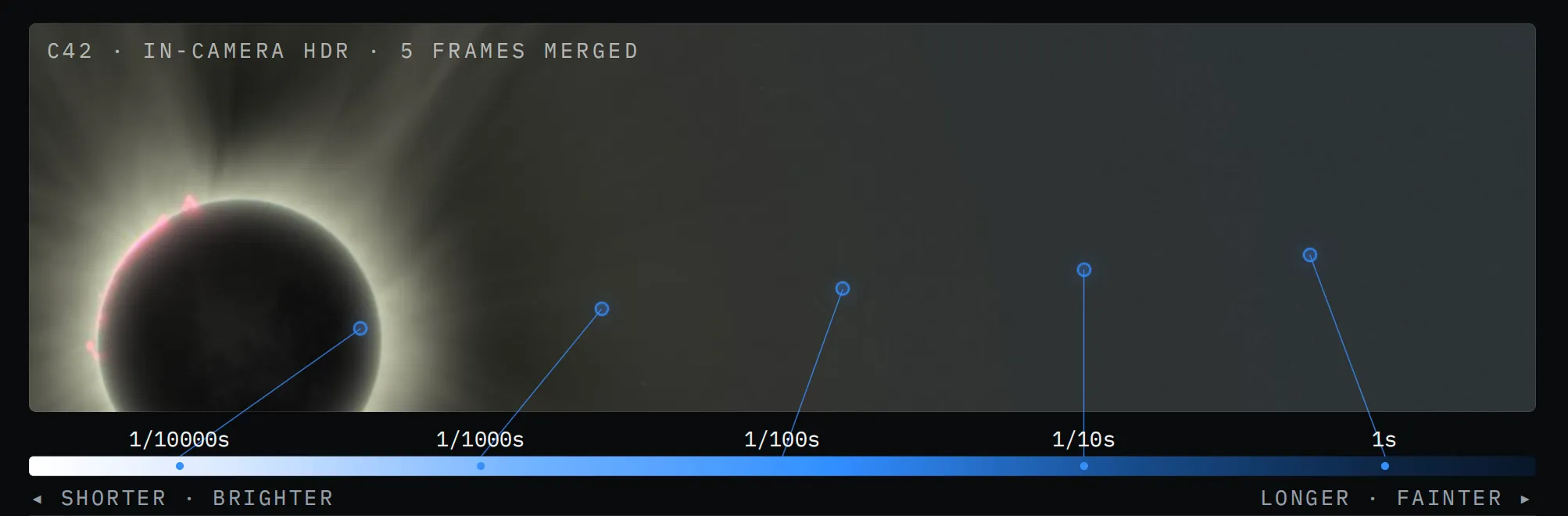
One burst takes under two seconds. The frames are then calibrated and fused in-camera with dark, bias, and flat correction. The result is a single RAW frame with the kind of headroom eclipse photographers usually have to fight for later on a laptop.
That matters because an eclipse punishes hesitation. Every cable swap, every software switch, every manual alignment step is another way to miss the moment. C42 pulls the exposure sequence, calibration, and fusion into one seamless imaging flow, so the camera can spend those critical seconds recording the sky instead of handing problems to the user.
03 | This Didn’t Start as a Product Feature
The HDR story behind C42 didn’t begin in a marketing deck. It began in 2015 with a reverse-engineered Sony sensor, a custom FPGA board, and a team trying to get closer to the raw signal.
That early prototype gave the team direct access to sensor data. Capture, calibration, and processing were no longer scattered across separate devices and software. The whole image path could be tested as one unified system.
In 2017, the prototype left the bench and went to Wyoming for the Great American Eclipse. Mounted on a telescope, it faced the kind of scene that exposes weak imaging systems immediately: a huge brightness range, almost no time, and no repeat attempts.
That field test became part of C42’s DNA. HDR wasn’t treated as a pretty effect added after capture. It became a way to build the camera around real sky problems.
04 | Beyond the Eclipse
HDR gets the headline here, but it’s only one part of the system.
Long nights fail for small reasons. A guide setup drifts. A sensor gets noisy. A burst outruns the storage. A cable catches. A laptop becomes the weakest part of the rig. C42 is built to remove those failure points one by one.
- Built-in Guiding reduces the need for a separate guide camera.
- Cooling gives long exposures a cleaner base.
- SSD storage keeps up with HDR bursts and heavy image capture.
- Wireless control lets you frame, focus, and download without building a cable nest in the dark.
That’s why the same imaging philosophy carries beyond eclipse work. Rho Ophiuchi, the Sadr Region, the Orion Winter Milky Way, and Death Valley HDR timelapses are very different subjects, but they all ask for the same thing: stable capture, clean data, and fewer ways for the night to fall apart.
Explore More C42 Samples
From eclipse HDR to deep-sky imaging, Milky Way work, and HDR timelapses, C42 is built around one simple obsession: recording the sky with more of its real light intact.
